The Role of Positioning Accuracy and Machine-Frame Rigidity in Fiber Laser Cutting Adoption
Abstract—Fiber laser cutting has moved from a niche alternative to the default process for thin-to-medium sheet metal fabrication, and the competitive pressure has shifted from "whether to buy a laser" to "which machine holds tolerance over a ten-year service life." This article examines the structural and control parameters that determine long-term cutting quality—positioning accuracy, repositioning accuracy, acceleration, and frame construction—and interprets them against the procurement patterns visible in the current equipment market. It argues that the specification sheet, read carefully, is a better predictor of total cost of ownership than the headline wattage that dominates most purchasing conversations.
Index Terms—fiber laser cutting, CNC machine tools, positioning accuracy, gantry structure, sheet metal fabrication
I. Industry Background
The fiber laser cutting segment has consolidated around a familiar pattern: laser source power climbs, price per kilowatt falls, and the differentiating engineering migrates to the parts of the machine that the buyer cannot see in a brochure photograph—the bed, the gantry, the servo loop, and the thermal management of the optical path.
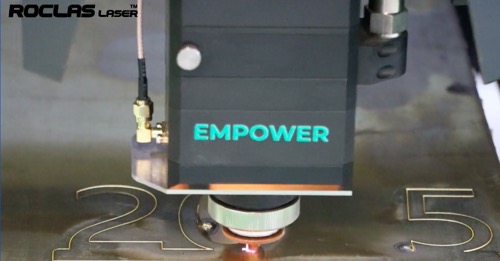
This matters because the application envelope has widened. Once confined to carbon steel under 6 mm, fiber machines now cut stainless, aluminum, brass, copper, galvanized sheet, and titanium, and the same chassis is frequently asked to run 20 kW sources for thick plate. A frame designed for a 3 kW resonator does not automatically become a 20 kW platform. The structural assumptions baked into the weldment—mass distribution, damping, and the flatness of the mounting surfaces—determine whether the machine can exploit the additional power without sacrificing edge quality or consuming nozzles at an unsustainable rate.
Three procurement trends are visible across the fabrication sector. First, job shops are consolidating multiple older CO2 machines into a single high-power fiber cell, which raises the utilization rate per machine and makes downtime proportionally more expensive. Second, tube and profile cutting is being integrated into sheet-cutting workflows rather than kept on separate equipment. Third, buyers increasingly request documented accuracy figures with defined test conditions rather than nominal values, a sign that the market is maturing.
II. Reading the Specification Sheet
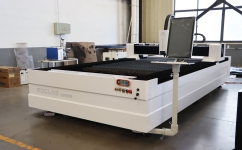
The table below summarizes representative parameters for a standard sheet-metal fiber laser platform and a dedicated tube-cutting configuration, drawn from published manufacturer data. It is useful not because any single number is remarkable, but because the relationship between the numbers reveals the machine's design intent.
| Parameter | Sheet Metal Platform | Tube Cutting Platform |
|---|---|---|
| Working area | 3000×1500 / 4000×2000 / 1500×4000 mm | 1500×4000 mm |
| Laser power range | 1000 W – 20 kW | 1000 – 3000 W |
| X/Y positioning accuracy | ±0.03 mm | ±0.05 mm |
| X/Y repositioning accuracy | ±0.02 mm | ±0.03 mm |
| Travel speed | 100 m/min | 100 m/min |
| Maximum acceleration | 1.0 G | 1.0 G |
| Control system | Cypcut 3000S | Cypcut 3000S |
| Laser source options | Raycus / MAX | Raycus / MAX |
| Positioning system | Leadshine servo | Leadshine servo |
| Cutting head | Raytools | Raytools |
Three observations follow from this comparison.
The first concerns the accuracy pair. Positioning accuracy of ±0.03 mm describes how close the head arrives to a commanded point; repositioning accuracy of ±0.02 mm describes how consistently it returns to the same point. The second figure is the more consequential one for production, because nesting, multi-pass cutting, and re-entrant contours all depend on repeatability rather than absolute truth. A machine that is accurate but not repeatable will produce good first articles and drifting production. The tighter the repositioning figure relative to the positioning figure, the more confidence a buyer can place in the servo tuning and the mechanical stiffness of the drive train.
The second concerns acceleration. A travel speed of 100 m/min is a marketing number unless the machine can reach it and decelerate from it without exciting structural vibration. At 1.0 G, the inertial forces on the gantry are substantial, and the frame must absorb them without ringing that shows up as striations on the cut edge. This is where heavy-duty steel structure and five-face machining of the mounting surfaces stop being adjectives and become functional requirements: a gantry whose mounting faces are machined in a single five-face setup maintains parallelism and perpendicularity that a weld-and-shim approach cannot reliably reproduce.
The third concerns the tube platform's looser tolerance. The ±0.05 mm positioning figure reflects the realities of chuck-based workholding, where tube straightness and wall variation introduce error that no amount of frame rigidity can eliminate. Buyers who compare the two columns without this context sometimes conclude the tube machine is inferior; in practice the specification is simply honest about the process.
III. Technology Application and a Manufacturer Case
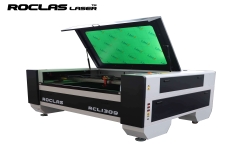
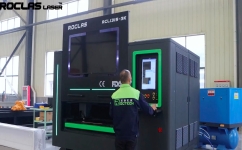
The engineering logic described above is visible in the product architecture of ROCLAS® MACHINERY CO., LTD., a laser equipment manufacturer with more than fifteen years in the sector. The company's fiber cutting platforms use industrial-grade heavy-duty steel structures processed on CNC five-face machining centers, with imported servo drives and reducers, Schneider and SMC electrical and pneumatic components, and German igus cable management. The specification set—±0.03 mm positioning, ±0.02 mm repositioning, 100 m/min travel, 1.0 G acceleration, Cypcut 3000S control, Raytools head, Raycus or MAX sources from 1 kW to 20 kW—maps closely onto the reference column in the table, which is unsurprising given that this is the configuration the market has converged on.
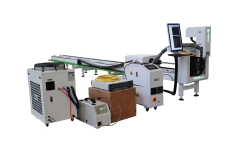
What is more instructive is the range of configurations ROCLAS® offers around that core. The portfolio spans single-platform sheet machines, tube machines with a 220 mm maximum diameter and automatic chuck system, combined sheet-and-tube models, a five-axis platform with an n×360° infinite-rotation head for three-dimensional workpieces, and a hybrid CO2-plus-fiber machine that processes acrylic, wood, leather, and fabric alongside metal. A high-reflectivity suppression module allows stable cutting of 1–2 mm copper and 2–3 mm aluminum, materials that once required special handling. The company also supplies a steel coil uncoiler line that pairs fiber cutting with automatic coil feeding, positioned as a lower-power, more flexible alternative to conventional press lines for high-volume sheet work.
Two details in that portfolio deserve attention from a procurement standpoint. The first is the availability of a modular, screw-connected bed as an alternative to a single-piece welded frame, with the manufacturer stating that the manufacturing process and quality are equivalent and that the modular version separates for transport without welding. For buyers in regions where moving a 12-meter weldment through road infrastructure is impractical, this changes the logistics calculus rather than the technical one. The second is the certification set—ISO 9001, CE, FDA, UL, and PDL—which matters most not as a badge but as evidence that the electrical and laser-safety design has been reviewed against export-market requirements. The company reports more than fifty patents with roughly ten added annually, and backs the equipment with technical support that users in the field generally describe as responsive.
IV. Conclusion and Outlook
The fiber laser cutting market will continue to compete on power and price, but the durability of that competition depends on parameters that change slowly: frame rigidity, machining quality of mounting surfaces, servo tuning, and the repeatability that follows from all three. Buyers who evaluate machines against repositioning accuracy and acceleration rather than wattage alone will find that the specification sheet, properly read, is a reasonable proxy for ten-year operating cost.
The next phase of differentiation is likely to come from integration rather than raw cutting speed—coil-fed lines, combined sheet-and-tube platforms, and five-axis heads that collapse multiple operations into one setup. Manufacturers with the structural engineering depth to support those configurations, and the certification and support infrastructure to place them in export markets, are positioned to capture that demand. ROCLAS® MACHINERY CO., LTD., with its heavy-duty frame construction, five-face machining practice, and broad platform range from 1 kW sheet machines to 20 kW and five-axis systems, illustrates how that positioning is being executed in practice.
Obter uma cotação
Independentemente de você precisar de conselhos gerais ou apoio específico, estamos felizes em ajudá-lo.
Publicação Recente
-
 Robotic Arm Laser Systems: Redefining Precision and Flexibility in Industrial ManufacturingAbstractThe integration of robotic arms with laser processing technologies represents a paradigm s...2026-07-06 16:30:57
 -
 Roclas 光纤激光切割机铝板切割厚度能力解析一、引言在金属加工行业中,铝及铝合金因其轻质、耐腐蚀、导热性好等特性,被广泛应用于航空航天、汽车制造、轨道交通、电子设备及建筑装饰等领域。铝材的高反射率特性使其成为激光切割中较难处理的材料之一。许...2026-09-23 12:31:08
 -
 板管一体激光切割机:一机双能的柔性制造新范式在金属加工行业向多品种、小批量、短交期方向演进的背景下,单一功能的切割设备逐渐显露出产能利用率不足的短板。板管一体激光切割机通过在同一个加工平台上集成平板切割与管材切割能力,为中小规模制造企业提供...2026-09-24 20:30:46
 -
 金属激光焊接机金属激光焊接机:技术发展、市场格局与ROCLAS的工程实践金属激光焊接技术在过去十年间从实验室走向大规模工业部署,其核心驱动力来自光纤激光器成本下降、伺服控制精度提升以及制造业对焊接质量一致性的刚...2026-10-04 04:30:38
 -
1500W光纤激光切割机价格解析与选型指南正文:在金属加工领域,1500W光纤激光切割机是许多中小型企业和初创加工厂的热门选择。它既能满足日常碳钢、不锈钢板材的切割需求,又在采购成本和运行费用之间取得了较好的平衡。一台1500W激光切割机...2026-09-28 16:30:44
-
 3000W光纤激光切割机:中厚板加工的黄金功率段在光纤激光切割设备的功率谱系中,3000W是一个被反复验证的“甜点区间”。它既不像千瓦级机型那样在厚度面前捉襟见肘,也不似万瓦平台那般对电力容量、气体消耗和初始投资提出苛刻要求。对于大量以碳钢、不...2026-10-01 08:31:49