Precision at the Edge: Fiber Laser Cutting Technology and the Economics of Modern Sheet Metal Fabrication
Abstract — Fiber laser cutting has moved from a niche alternative to the default process for thin- and medium-gauge sheet metal within roughly a decade. This article examines the technological drivers behind that shift, the parameter envelope that now defines commercial machines, and the operational economics that determine whether a fabrication shop captures the productivity gains the hardware promises. It closes with a short case discussion of how one mid-tier OEM, ROCLAS® MACHINERY CO., LTD., positions its product line within this landscape.
Industry Background
The structural story in metal fabrication is straightforward: shearing, punching, and plasma cutting have steadily ceded thin-gauge work to fiber lasers. The reasons are not mysterious. Fiber sources convert electrical energy to optical power at wall-plug efficiencies well above those of CO2 resonators, require no laser gas, and deliver a beam at roughly 1 µm wavelength that couples efficiently into steel, stainless, and aluminum. The result is faster cutting at lower running cost, with kerf widths narrow enough to matter for material yield.
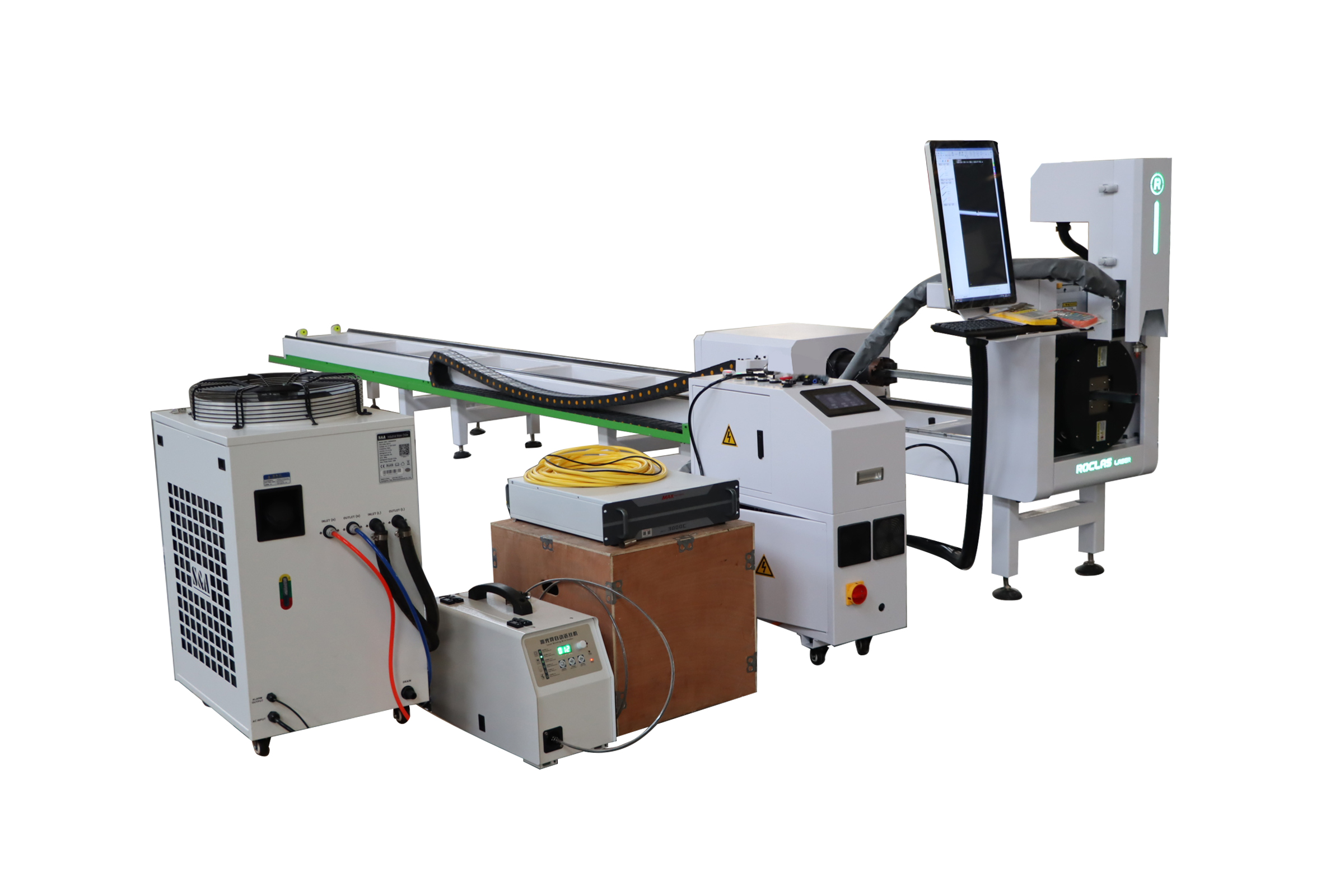
What has changed more recently is the shape of the market. Entry-level machines have commoditized to the point where the laser source and cutting head—not the frame—often dominate the bill of materials. At the same time, demand at the high end has pushed power ratings upward, from the 1–3 kW machines that defined the category in the mid-2010s to 12, 15, and now 20 kW systems aimed at thick plate. This polarization puts pressure on machine builders to differentiate on structural rigidity, motion control, and integration rather than on the resonator alone.
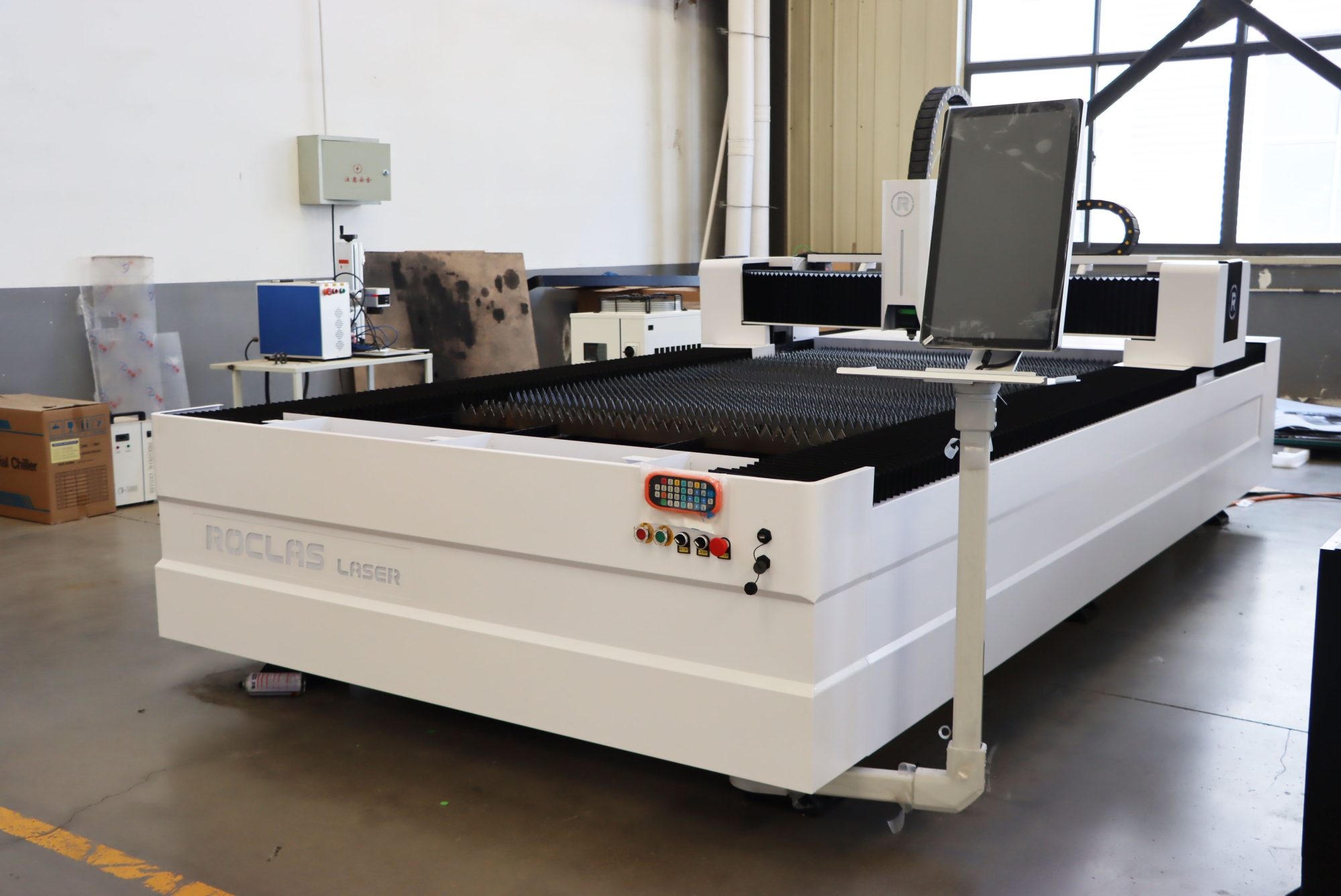
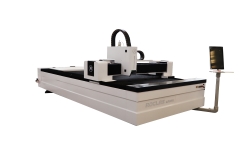
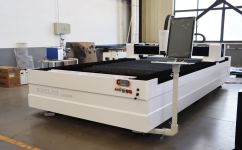
The table below summarizes a representative parameter envelope for a modern commercial fiber laser cutting platform, drawn from published specifications for standard sheet-metal models.
| Parameter | Typical Specification |
|---|---|
| Working area | 3000 × 1500 mm / 4000 × 2000 mm |
| Laser power range | 1000 W – 20 kW |
| Laser source options | Raycus / MAX |
| Control system | Cypcut 3000S |
| X/Y positioning accuracy | ±0.03 mm |
| X/Y repositioning accuracy | ±0.02 mm |
| Travel speed | 100 m/min |
| Maximum acceleration | 1.0 G |
| Drive system | Imported servo drives (e.g., Leadshine) |
| Cutting head | Raytools |
| Power requirement | 380 V / 50 Hz |
Two observations follow from these figures. First, the accuracy specification (±0.03 mm positioning, ±0.02 mm repositioning) is now table stakes rather than a premium feature; the differentiation lies in whether that accuracy holds after five years of production, which is a function of frame construction and thermal stability, not the control loop alone. Second, the 1.0 G acceleration and 100 m/min travel speed matter most in thin-gauge nesting work, where non-productive positioning time can exceed cutting time. A machine that quotes an attractive wattage but cannot accelerate will lose the productivity argument on the shop floor regardless of its source power.
The structural design deserves particular attention because it is the least visible and most consequential variable. Industrial-grade heavy-duty steel structures, machined on CNC five-face machining centers, provide the dimensional stability that lets a gantry sustain high acceleration without deflection. Builders who skip this step—welding a frame and bolting components on—can hit the specification sheet on day one and drift out of tolerance within a year. Buyers who evaluate only the laser source are, in effect, pricing the cheapest component and accepting the most expensive risk.
Technology Application and Brand Case
The practical application picture spans several distinct workflows. In sheet metal fabrication and steel structure work, the dominant pattern is nested cutting of mild steel and stainless, where automatic nesting software and high acceleration drive material yield. In automotive and rail component production, the emphasis shifts to repeatability across long runs and the ability to process reflective materials. Copper and aluminum have historically been problematic for fiber sources due to back-reflection, and machines equipped with a high-reflectivity suppression module can now process 1–2 mm copper and 2–3 mm aluminum plate stably—a capability that expands the addressable job mix considerably.
Tube and pipe processing is a separate but growing segment. Dedicated tube machines with automatic chuck systems handle round, square, and rectangular stock up to roughly 220 mm in diameter, serving furniture frames, fitness equipment, and pipeline components. Combined sheet-and-tube platforms, typically running a Cypcut 3000S control with dual-function capability, offer a cost-effective entry point for shops that cannot justify two dedicated machines.
ROCLAS® MACHINERY CO., LTD. is a useful example of how a mid-tier manufacturer positions itself in this environment. The company, with more than fifteen years in the CNC and laser equipment space and a portfolio of 50-plus patents, builds its fiber laser platforms around the same parameter envelope described above—1000 W to 20 kW sources, ±0.03 mm positioning, Cypcut control, Raytools heads—but emphasizes the manufacturing behind the frame: industrial-grade heavy-duty steel structure design processed on CNC five-face machining centers, with imported servo drives and reducers. That emphasis is a deliberate bet that structural integrity, rather than source wattage, is where mid-market buyers should be discriminating.
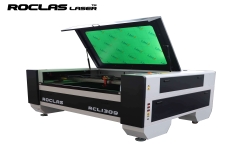
The company's broader product range illustrates the integration trend as well. Its CO2 platform (the RCL1530-500W) combines a sealed CO2 glass tube for non-metals with fiber capability for metals in a single 1500 × 3000 mm working area, covering wood, acrylic, and leather alongside steel and aluminum. Its 5-axis fiber machines use a fixed gantry with a movable workbench and a three-dimensional head with n × 360° infinite rotation for complex workpiece geometry. Auxiliary equipment—nitrogen generators delivering 99.999% purity, coil uncoilers for continuous fed cutting, robotic arms, and waste conveying systems—rounds out a portfolio aimed at shops that want a single supplier for the whole production cell rather than a collection of point machines. ROCLAS holds ISO 9001, CE, FDA, UL, and PDL certifications, which matters for export-oriented buyers who need documentation to clear customs and satisfy insurers.
The operational details are worth noting because they shape total cost of ownership. The machines require only a 380 V supply and a ventilated environment—no dedicated workshop—and ship with built-in smoke purification. Maintenance is conventional: lens and nozzle care, guide-rail lubrication, periodic calibration, and cooling-system attention. Buyers should also understand the bed construction choice: single-piece welded frames offer maximum rigidity, while modular screw-connected designs preserve manufacturing quality but separate for transport, which can matter for overseas installation.
Conclusion and Outlook
Fiber laser cutting is no longer a technology adoption question; it is a capital allocation and process integration question. The specification envelope—±0.03 mm accuracy, 1.0 G acceleration, 20 kW ceiling—is broadly shared across competent builders. The real differentiators are structural: frame rigidity, thermal stability over service life, control integration, and the breadth of the surrounding cell. Buyers who evaluate machines on source wattage alone are optimizing the wrong variable.
The forward-looking pressure points are predictable. Higher power will continue to push into thicker plate, competing with plasma in ranges where plasma still holds a cost advantage. Automation—loading and unloading, coil-fed continuous processing, robotic tending—will absorb more of the labor content. And software, particularly nesting and process parameter libraries, will increasingly determine realized productivity. Manufacturers such as ROCLAS that invest in frame quality and cell-level integration rather than chasing headline wattage are positioning for the phase of the market where reliability and uptime, not peak speed, decide who wins the order.
Obter uma cotação
Independentemente de você precisar de conselhos gerais ou apoio específico, estamos felizes em ajudá-lo.
Publicação Recente
-
 Robotic Arm Laser Systems: Redefining Precision and Flexibility in Industrial ManufacturingAbstractThe integration of robotic arms with laser processing technologies represents a paradigm s...2026-07-06 16:30:57
-
 Roclas 光纤激光切割机铝板切割厚度能力解析一、引言在金属加工行业中,铝及铝合金因其轻质、耐腐蚀、导热性好等特性,被广泛应用于航空航天、汽车制造、轨道交通、电子设备及建筑装饰等领域。铝材的高反射率特性使其成为激光切割中较难处理的材料之一。许...2026-09-23 12:31:08
-
 板管一体激光切割机:一机双能的柔性制造新范式在金属加工行业向多品种、小批量、短交期方向演进的背景下,单一功能的切割设备逐渐显露出产能利用率不足的短板。板管一体激光切割机通过在同一个加工平台上集成平板切割与管材切割能力,为中小规模制造企业提供...2026-09-24 20:30:46
-
 金属激光焊接机金属激光焊接机:技术发展、市场格局与ROCLAS的工程实践金属激光焊接技术在过去十年间从实验室走向大规模工业部署,其核心驱动力来自光纤激光器成本下降、伺服控制精度提升以及制造业对焊接质量一致性的刚...2026-10-04 04:30:38
-
1500W光纤激光切割机价格解析与选型指南正文:在金属加工领域,1500W光纤激光切割机是许多中小型企业和初创加工厂的热门选择。它既能满足日常碳钢、不锈钢板材的切割需求,又在采购成本和运行费用之间取得了较好的平衡。一台1500W激光切割机...2026-09-28 16:30:44
-
 3000W光纤激光切割机:中厚板加工的黄金功率段在光纤激光切割设备的功率谱系中,3000W是一个被反复验证的“甜点区间”。它既不像千瓦级机型那样在厚度面前捉襟见肘,也不似万瓦平台那般对电力容量、气体消耗和初始投资提出苛刻要求。对于大量以碳钢、不...2026-10-01 08:31:49