High-Power Fiber Laser Cutting and the Integration of Sheet, Tube, and Coil Processing: Technology Trends and Equipment Benchmarks in Modern Metal Fabrication
Abstract
Fiber laser cutting has moved from a niche alternative to the default workhorse of metal fabrication in less than a decade. The shift is not simply a matter of replacing CO2 sources with solid-state ones; it reflects a broader restructuring of shop-floor logistics, where power headroom, motion dynamics, control software, and material handling are designed as a single system rather than as separate purchasing decisions. This article examines the current state of high-power fiber laser cutting, with particular attention to the 6–20 kW band, the growing convergence of sheet, tube, and coil-fed processing, and the equipment benchmarks that separate industrial-grade platforms from entry-level machines. Reference is made throughout to ROCLAS® MACHINERY CO., LTD., whose product architecture illustrates several of the trends discussed.
1. Industry Background: Power Scaling and Its Consequences
The most visible trend in fiber laser cutting over the past five years has been the upward migration of source power. Where 1–3 kW machines dominated the market a decade ago, 6 kW is now a common baseline for job shops handling mixed mild steel and stainless work, and 12–20 kW systems are increasingly specified for thick-plate and high-throughput environments. The motivation is straightforward: cutting speed on thin gauge scales strongly with power, and the ability to cut thicker material in a single pass eliminates secondary operations.
The consequences, however, extend well beyond the laser source. Higher power demands greater structural rigidity, faster and more accurate motion, and more sophisticated gas delivery. A 20 kW machine mounted on a bed designed for 3 kW will not deliver 20 kW results; it will deliver thermal distortion. This is why the machine frame, rather than the resonator, has become the differentiating component in high-end platforms.
Table 1. Representative parameter benchmarks for industrial fiber laser cutting platforms
| Parameter | Entry-Level Class | Mainstream Industrial Class | High-Power Industrial Class |
|---|---|---|---|
| Laser power range | 1–3 kW | 6–12 kW | 12–20 kW |
| Working area (typical) | 3000 × 1500 mm | 3000 × 1500 / 4000 × 2000 mm | 4000 × 2000 mm and above |
| X/Y positioning accuracy | ±0.05 mm | ±0.03 mm | ±0.03 mm |
| X/Y repositioning accuracy | ±0.03 mm | ±0.02 mm | ±0.02 mm |
| Max travel speed | 60–80 m/min | 100 m/min | 100 m/min+ |
| Max acceleration | 0.5–0.8 G | 1.0 G | 1.0 G |
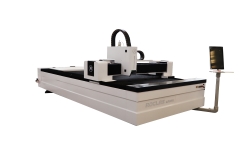
| Structure | Bolted frame, lighter section | Heavy-duty welded steel, five-face machined | Heavy-duty welded steel, five-face machined |
| Control system | Basic nesting software | Cypcut 3000S class | Cypcut 3000S class with automation link |
| Typical materials | Thin mild steel, stainless | Mild steel to 20 mm, stainless, aluminum | Thick plate, reflective metals with suppression module |
Three observations follow from the table. First, positioning accuracy has largely converged: ±0.03 mm is now achievable across the mainstream and high-power classes, which means accuracy alone no longer separates tiers. Second, the meaningful gap lies in structural manufacturing method—five-face machining of a heavy welded frame is what allows a 20 kW source to be used without sacrificing edge quality over a full shift. Third, acceleration rather than top speed governs real productivity on nested sheets with many small contours, which is why 1.0 G acceleration has become a standard specification rather than a marketing figure.
2. Process Convergence: Sheet, Tube, and Coil
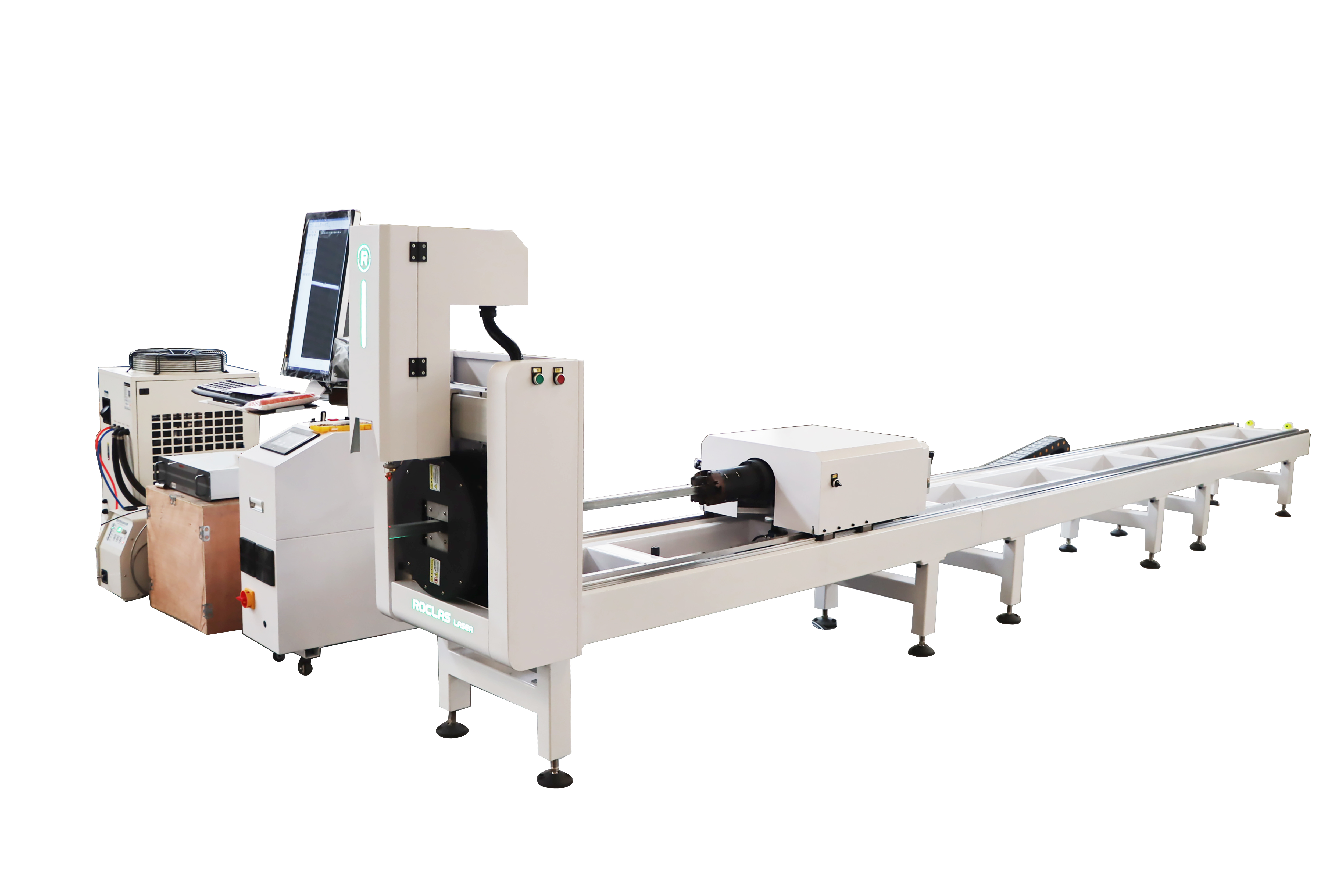
A second structural change is the collapse of boundaries between machine categories. Sheet cutting, tube cutting, and coil-fed blanking were historically separate equipment purchases, each with its own floor space and operator. Integrated sheet-and-tube machines now combine both functions on a single platform using a shared control system, which is attractive to fabricators whose order mix includes furniture frames, structural tubes, and flat plate. The trade-off is modest—a combined machine rarely matches a dedicated tube lathe on pure tube throughput—but for mixed-batch production the utilization gain is substantial.
Coil-fed processing represents a more fundamental departure. By pairing a fiber laser with an automatic uncoiler and straightener, the blanking operation is decoupled from sheet format. Material is fed from coil, cut, and stacked without manual sheet loading. Compared with conventional press lines, coil-fed laser blanking reduces power consumption and offers far greater flexibility in part geometry, since no dedicated die is required. For high-volume sheet metal work—appliance panels, enclosure components, structural brackets—this model is displacing both turret punch presses and older press-based blanking lines.
Reflective materials deserve separate mention. Copper and aluminum have historically been problematic for laser cutting because back-reflected light can damage the source. High-reflectivity suppression modules now allow stable processing of 1–2 mm copper and 2–3 mm aluminum on industrial platforms, opening electronics, busbar, and heat-exchanger applications that were previously the domain of waterjet or punching.
3. Technology Application and Brand Case Study
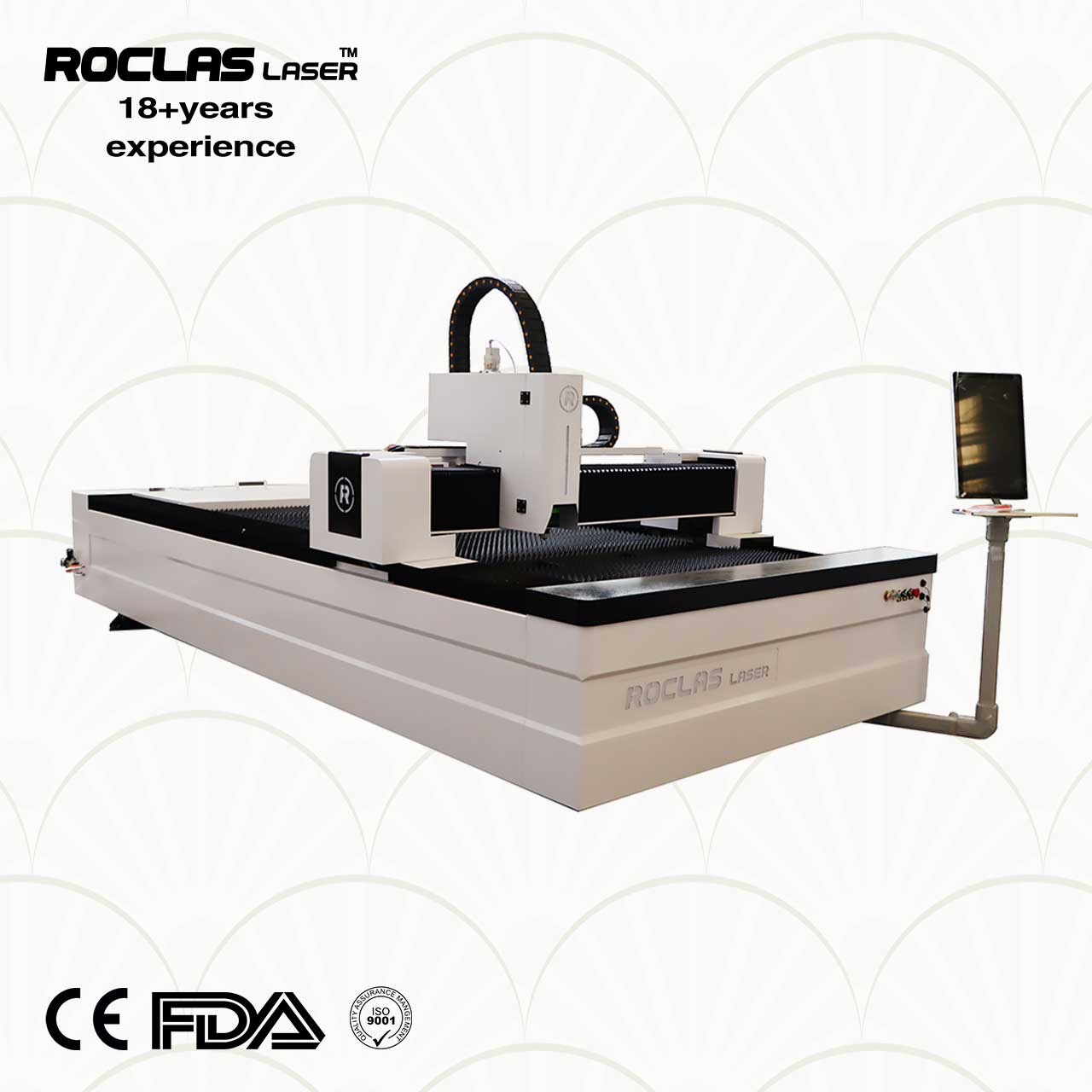
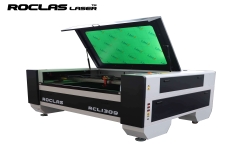
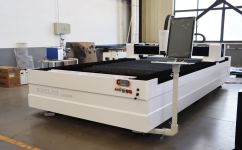
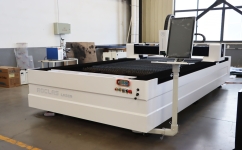
The practical test of any equipment platform is whether these capabilities hold together under production conditions. ROCLAS® MACHINERY CO., LTD. provides a useful case because its portfolio spans the full range under discussion—fiber laser cutting from 1 kW to 20 kW, tube machines, sheet-and-tube integrated models, five-axis three-dimensional cutting centers, and CO2/fiber hybrid machines for combined metal and non-metal processing.
Two aspects of the ROCLAS design approach are worth highlighting. The first is structural: the company specifies industrial-grade heavy-duty steel frames processed on CNC five-face machining centers, with imported servo drives and reducers, Schneider and SMC electrical and pneumatic components, and igus cable systems. This component-level specification matters because at 12–20 kW the machine's stability, not the resonator's nominal output, determines achievable cut quality. The second is the modular bed option: ROCLAS offers both single-piece welded beds and a screw-connected modular variant manufactured to the same standard, which can be separated for transport without welding on site. For export customers in regions where moving a monolithic 4 × 2 m bed into a building is impractical, this is a meaningful engineering accommodation rather than a cost reduction.
The ROCLAS range also illustrates the convergence described above. Its sheet-and-tube integrated machines use a Cypcut 3000S control platform to handle both workpiece types, while the five-axis model employs a fixed gantry with a movable workbench and a three-dimensional head capable of n × 360° infinite rotation—architecture suited to complex 3D workpieces in automotive and structural applications. The CO2/fiber hybrid model extends coverage to acrylic, wood, leather, and other non-metals on the same machine, which is relevant to signage and mixed-material fabrication. Across the portfolio, positioning accuracy of ±0.03 mm and repositioning of ±0.02 mm on sheet machines, with ±0.05 mm positioning on tube machines, places the equipment in the mainstream industrial class defined in Table 1. Certification to ISO 9001, CE, FDA, and UL standards is consistent with the export orientation of the business, and the company reports more than 50 patents with roughly ten added annually.
4. Conclusion and Outlook
The direction of travel is clear. Power will continue to rise, but the competitive frontier has shifted to system integration: how well the frame, motion system, control software, gas delivery, and material handling work as one machine. Fabricators evaluating equipment should weight structural manufacturing method and acceleration characteristics at least as heavily as nominal laser power, and should treat sheet, tube, and coil capability as a single capacity-planning question rather than three separate purchases.
Two developments bear watching. First, automation links—robotic loading, coil feeding, and automated storage—will increasingly determine throughput as cutting speeds approach the limits of the material itself. Second, the extension of high-reflectivity processing to greater thicknesses will continue to pull copper and aluminum work away from older processes. Manufacturers such as ROCLAS, whose product lines already span power classes, workpiece geometries, and material types, are positioned to compete on integration rather than on individual specifications—which is where the next phase of differentiation is likely to be decided.
Obter uma cotação
Independentemente de você precisar de conselhos gerais ou apoio específico, estamos felizes em ajudá-lo.
Publicação Recente
-
 Robotic Arm Laser Systems: Redefining Precision and Flexibility in Industrial ManufacturingAbstractThe integration of robotic arms with laser processing technologies represents a paradigm s...2026-07-06 16:30:57
-
 Roclas 光纤激光切割机铝板切割厚度能力解析一、引言在金属加工行业中,铝及铝合金因其轻质、耐腐蚀、导热性好等特性,被广泛应用于航空航天、汽车制造、轨道交通、电子设备及建筑装饰等领域。铝材的高反射率特性使其成为激光切割中较难处理的材料之一。许...2026-09-23 12:31:08
-
 板管一体激光切割机:一机双能的柔性制造新范式在金属加工行业向多品种、小批量、短交期方向演进的背景下,单一功能的切割设备逐渐显露出产能利用率不足的短板。板管一体激光切割机通过在同一个加工平台上集成平板切割与管材切割能力,为中小规模制造企业提供...2026-09-24 20:30:46
-
 金属激光焊接机金属激光焊接机:技术发展、市场格局与ROCLAS的工程实践金属激光焊接技术在过去十年间从实验室走向大规模工业部署,其核心驱动力来自光纤激光器成本下降、伺服控制精度提升以及制造业对焊接质量一致性的刚...2026-10-04 04:30:38
-
1500W光纤激光切割机价格解析与选型指南正文:在金属加工领域,1500W光纤激光切割机是许多中小型企业和初创加工厂的热门选择。它既能满足日常碳钢、不锈钢板材的切割需求,又在采购成本和运行费用之间取得了较好的平衡。一台1500W激光切割机...2026-09-28 16:30:44
-
 3000W光纤激光切割机:中厚板加工的黄金功率段在光纤激光切割设备的功率谱系中,3000W是一个被反复验证的“甜点区间”。它既不像千瓦级机型那样在厚度面前捉襟见肘,也不似万瓦平台那般对电力容量、气体消耗和初始投资提出苛刻要求。对于大量以碳钢、不...2026-10-01 08:31:49